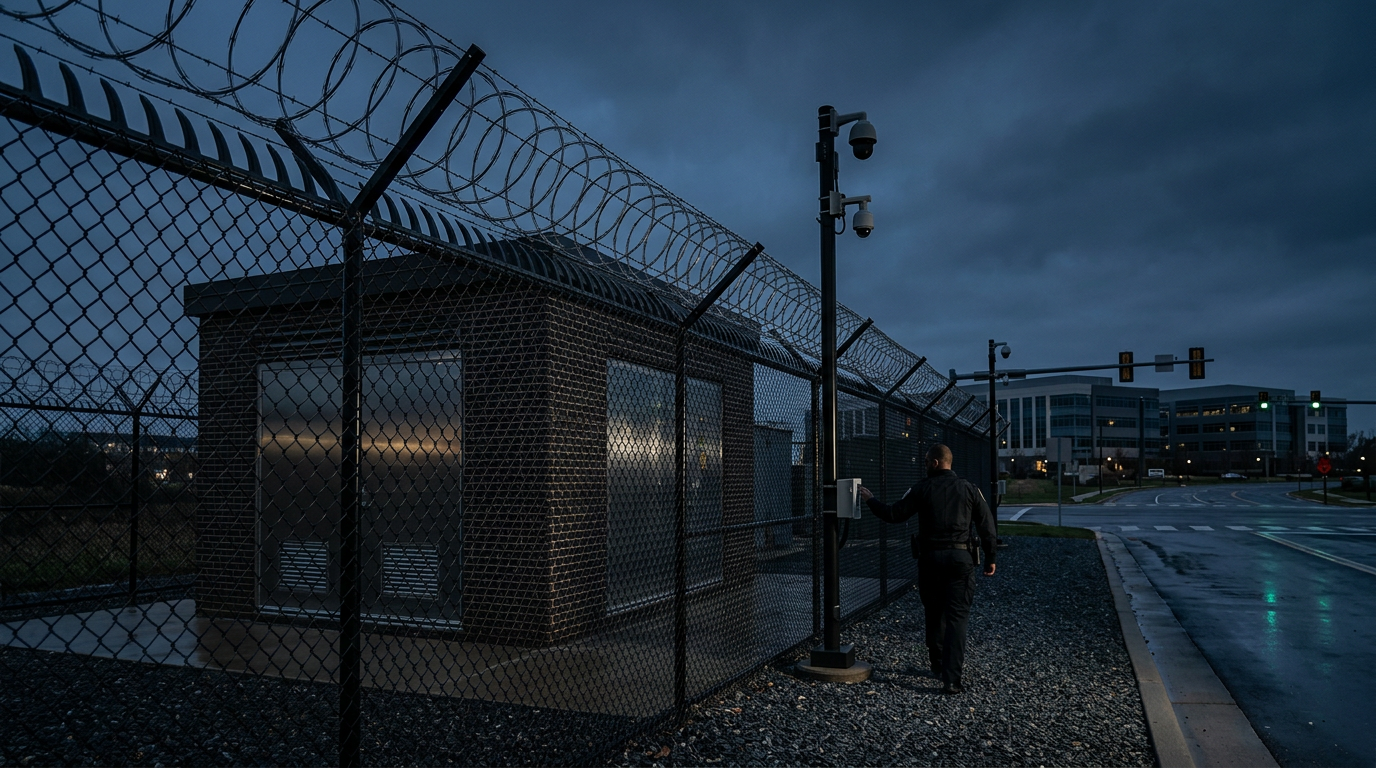
Commercial facilities, regional distribution centers, and corporate office parks rely heavily on external utilities to maintain continuous operations. Pad-mounted transformers, backup diesel generators, cooling towers, and medium-voltage switchgear represent high-value targets that are frequently positioned outside primary building envelopes. In industrial parks and corporate campuses throughout Prince William County and the greater Northern Virginia corridor, securing these exterior mechanical yards is as vital to business survival as interior access control.
Breaches of exterior utility yards expose facilities to catastrophic downtime, equipment replacement lead times exceeding forty weeks, and severe life-safety hazards. An effective utility enclosure program balances physical containment, anti-scale engineering, and early electronic detection to mitigate unauthorized access before vital infrastructure is compromised.
Physical Barrier Architecture and Resistance Ratings
Standard commercial chain-link fencing is often insufficient for protecting critical utility infrastructure. Traditional woven fabric can be breached in seconds using hand tools, and standard mesh diamonds provide immediate toe-holds for scaling. Facility planners increasingly specify high-security welded-wire mesh engineered to meet standards such as ASTM F2781 (Standard Practice for Testing Forced-Entry Resistance of Fence Systems).
Rigid, high-density wire panels feature apertures too narrow to permit finger- or toe-holds and resist standard bolt cutters. Posts and framework must be anchored into continuous concrete grade beams or deep concrete footings to prevent lifting or vehicular wedging.
Where aesthetics or municipal zoning guidelines in jurisdictions such as Manassas or Manassas Park prohibit industrial wire mesh, solid precast concrete walls or louvered steel perimeter structures are deployed. These barriers eliminate line-of-sight reconnaissance while providing acoustic dampening for backup generators and transformer hum. Regardless of material, the minimum recommended height for critical utility enclosures is eight feet, augmented by anti-scale overhangs or outriggers angled outward at forty-five degrees.
Clear Zones and Environmental Sightlines
A physical barrier is only as effective as the visual environment surrounding it. Enclosures require designated clear zones on both the exterior and interior perimeter perimeters:
- Exterior Clear Zone (10–15 Feet): Ground cover must be kept graded and clear of tree branches, stacked pallets, refuse containers, or equipment that could serve as an elevated climbing platform.
- Interior Clearance (5–10 Feet): Adequate clearance between the fence line and energized electrical cabinets protects against arc flash risks, satisfies National Electrical Code (NEC) maintenance spacing, and prevents an intruder from using equipment housings to descend safely into the yard.
- Ground Penetration Barriers: Fencing should be embedded a minimum of six to twelve inches below grade or secured to concrete curbs to prevent burrowing or manual lifting of the fabric bottom.
- Drainage and Trench Protection: Where stormwater swales or utility trenching pass beneath the perimeter, heavy steel grating must be mechanically anchored to prevent unmonitored human passage.
Electronic Intrusion Detection and Video Verification
Physical barriers delay intrusion, but electronic systems must detect and verify the event in real time. Because exterior utility enclosures face variable weather, wildlife, and ambient vehicle vibration, intrusion systems must be calibrated to suppress nuisance alarms while maintaining high probability of detection.
Fence-mounted vibration sensors (fiber-optic or piezoelectric cable systems) detect cutting, climbing, or panel lifting. When paired with dual-technology motion sensors (combining passive infrared and high-frequency microwave) inside the yard, operators gain layered verification.
Thermal analytics cameras positioned along the fence line provide reliable classification of human movement through darkness, fog, and precipitation without requiring glaring, continuous floodlights that draw neighbor complaints or violate dark-sky covenants. Once a tripwire is breached, fixed high-resolution optical cameras can slew to the target, verifying the intrusion and expediting dispatched protective response.
Executive Note — EGS Analysis Mechanical and electrical yards are the operational spine of any commercial campus. Treating exterior utility security as an afterthought compromises overall operational continuity and unnecessarily expands an asset's liability footprint. True proactive risk mitigation requires integrating heavy physical resistance with intelligent verification, ensuring external vulnerabilities are contained before primary operations are interrupted.
Educational Sidebar: Five-Point Utility Enclosure Audit
Facility managers and engineering directors can evaluate their utility perimeter using this operational checklist:
- Hardware Integrity: Inspect all perimeter gates for welded hinges, fully shrouded padlock hasps, and drop rods that seat at least six inches into stationary ground receivers.
- Clear Zone Verification: Ensure landscape maintenance contracts mandate seasonal trimming of all foliage within ten feet of the fence boundary.
- Ground-Line Survey: Identify any washouts, erosion channels, or soft soil depressions exceeding four inches beneath fence fabric or concrete panels.
- Signage Compliance: Verify bilingual high-voltage and restricted-access warning signs are posted at intervals no greater than fifty feet and at all access points.
- Tamper Interlocking: Confirm that all service gates feature monitored door-position switches tied directly into the facility's central access control system.
EGS Security Solutions publishes a complimentary threat & vulnerability assessment framework for facility directors in the DMV. Request it here: https://egssecuritysolutions.com/locations/manassas.