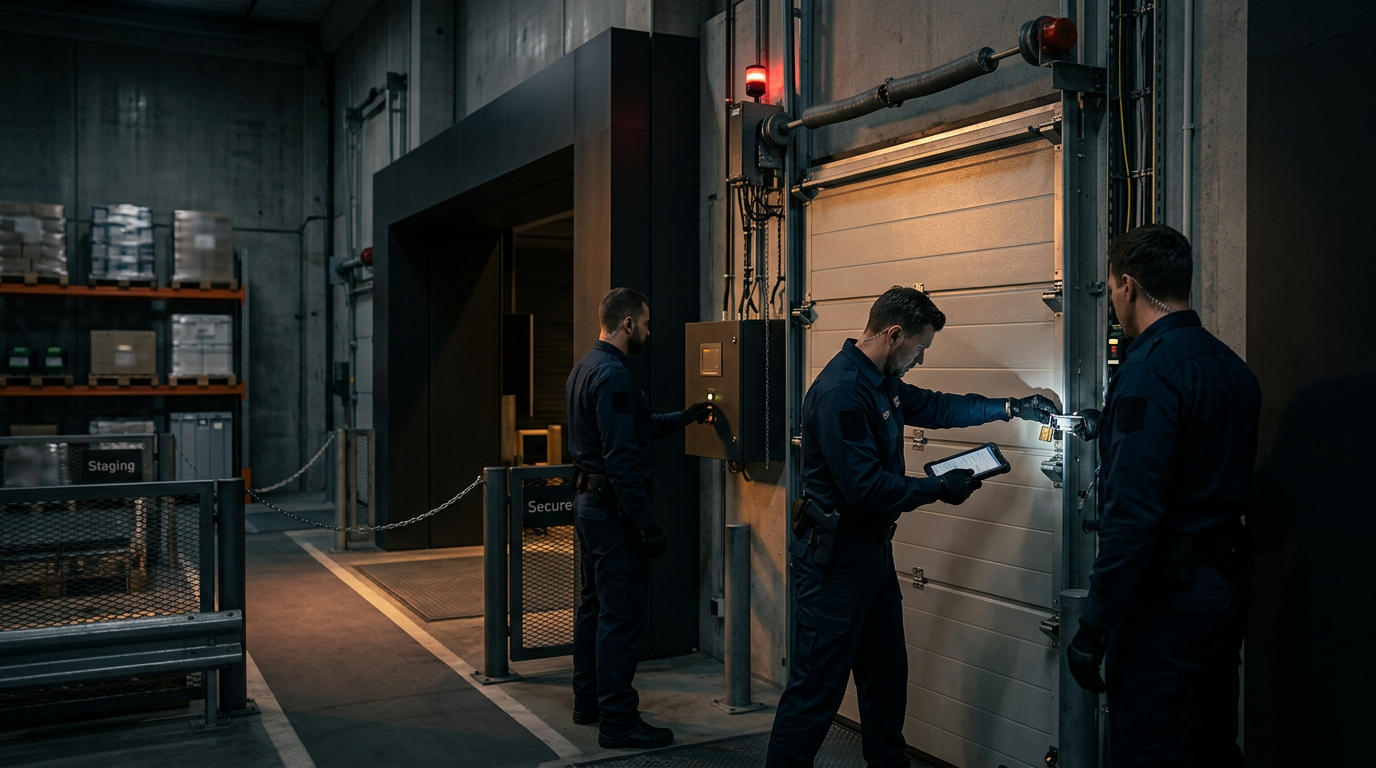
Commercial loading docks serve as primary logistics nodes for industrial properties, corporate distribution hubs, and mixed-use commercial centers across Prince William County and the greater Manassas region. Because these portals facilitate high volumes of freight, third-party carrier personnel, and external inventory, they represent one of the most complex operational boundaries within a facility's physical envelope.
Securing a loading bay requires balancing fluid logistics throughput against unauthorized ingress, cargo theft, and premises liability hazards. Establishing a defensible perimeter across the dock environment demands structured procedural checkpoints, integrated door controls, and spatial segregation between freight handlers and core facility corridors.
Spatial Segregation and Driver Staging Controls
One of the most persistent vulnerabilities in distribution and warehousing environments is unmonitored carrier access to administrative and production spaces. External drivers frequently exit trailers to obtain bills of lading or locate receiving staff, inadvertently bypassing interior electronic access controls.
A defensible dock design establishes an isolated logistics lounge or intake vestibule physically segregated from main production floors and storage bays. This enclosure should feature hard-walled partitions, magnetic shear locks tied to reception desks, and dedicated restroom facilities. By providing necessary amenities within a restricted perimeter, facility managers maintain life safety compliance while preventing unescorted third parties from entering secure operational zones.
Clear directional floor striping and automated egress barriers should reinforce these spatial boundaries. Signage alone rarely deters non-compliant foot traffic; physical access segregation remains the recognized standard for preventing internal wandering.
Trailer Restraints and Overhead Door Interlocks
Overhead roll-up bay doors present dual vulnerabilities: unauthorized physical breaching and accidental premature trailer departure. Modern perimeter architecture integrates automated vehicle restraints directly into overhead door control sequences to mitigate both operational and physical risks.
In an interlocked configuration, dock levellers and overhead doors remain mechanically and electrically locked until an incoming trailer's rear-impact guard is captured by an automated vehicle restraint. Once engaged, the dock management console permits the overhead door to raise. Conversely, the restraint cannot release the trailer chassis until the dock leveler has returned to its stored position and the overhead roll-up door is fully closed and latched.
This interlock sequence eliminates instances where overhead doors remain raised unattended between offloading cycles—a common scenario that invites opportunist trespass and creates severe climate-control losses.
High-Security Cargo Seal Verification Workflows
Incoming and outgoing freight integrity depends on rigorous chain-of-custody documentation, specifically regarding mechanical security seals. Relying solely on external drivers or receiving clerks to visually confirm seal numbers creates significant evidentiary vulnerabilities during post-incident loss investigations.
A standard receiving protocol should incorporate systematic verification steps before any seal is severed:
- Dual-Signoff Inspection: A designated receiving specialist and the delivery driver must jointly inspect the high-security bolt seal (compliant with ISO 17712 standards) for mechanical deformation, twisting, or thermal tampering prior to removal.
- Digital Photographic Capture: High-resolution fixed imaging or handheld scanners record the seal's embossed alpha-numeric identifier while still affixed to the container locking rod.
- Bill of Lading Reconciliation: The verified identifier is cross-referenced against the digital manifest; discrepancies require immediate supervisor escalation and containment of the trailer before the bay door opens.
- Physical Chain-of-Custody Retention: Severed bolt seals should not be discarded; facilities maintain an indexed retention bin for a minimum of 30 days to support claims adjudication or formal investigations.
Penetration Hardening and Environmental Monitoring
Dock leveler pits, trash compactors, and personnel egress doors adjacent to bay openings represent secondary points of compromise. Leveler pits often feature small gaps around curb angles that allow mechanical tools or contraband passage when lips are extended.
Installing brush weather seals backed by steel brush retainers eliminates line-of-sight into the pit and discourages pest ingress while providing light tamper resistance. Personnel doors opening onto the truck apron must be devoid of exterior hardware and equipped with anti-pry astragals, interior magnetic position switches, and local audible prop alarms integrated with the primary video management platform.
Executive Note — EGS Analysis Industrial and mixed-use logistics assets require deliberate alignment between facility engineering and operational protocol. Incorporating bay access controls and automated interlocks directly into daily logistics routines supports operational continuity while substantially reducing an organization's liability footprint. True physical security in distribution environments is achieved through proactive risk mitigation, converting high-turnover transfer points into structured, verifiable access thresholds.
Educational Sidebar: Loading Dock Receiving Audit Checklist
Facility directors and property managers can evaluate their receiving dock posture using this four-tier baseline review:
- Threshold Control: Are overhead roll-up doors electrically interlocked with vehicle restraints, preventing doors from remaining elevated when bays are unoccupied?
- Carrier Segregation: Is third-party carrier movement strictly restricted to a secure driver staging vestibule equipped with self-closing, access-controlled interior doors?
- Seal Accounting: Does the facility enforce an ISO 17712-compliant bolt seal verification protocol featuring dual-party signoff and photographic manifest matching?
- Perimeter Exceptions: Are side personnel doors audited monthly for proper latch alignment, functional door closers, and local prop-alarm sounders?
EGS Security Solutions publishes a complimentary threat & vulnerability assessment framework for facility directors in the DMV. Request it here: https://egssecuritysolutions.com/locations/manassas