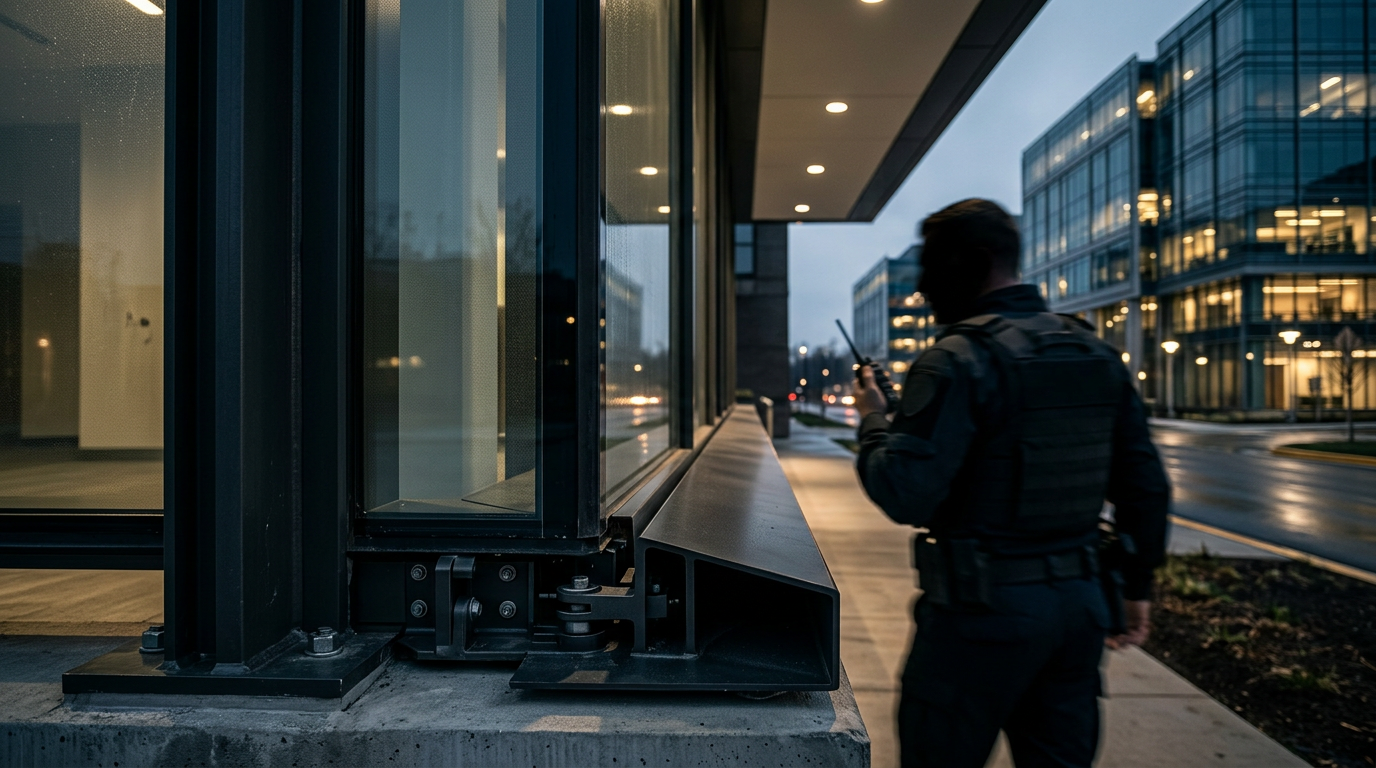
Architectural glass represents one of the most significant physical vulnerabilities in commercial building envelopes. Ground-level storefronts, curtain walls, and accessible second-story windows offer natural lines of sight and aesthetic appeal, but standard annealed or tempered glass provides minimal resistance against deliberate impact. When addressing physical intrusion, civil disturbance, or forced-entry attempts, facility planners must evaluate window assemblies not merely as individual panes of glass, but as integrated fenestration systems consisting of the pane, protective film or laminate, attachment mechanism, and surrounding structural frame.
Material Ratings and Performance Benchmarks
Standard commercial glass generally falls into three basic categories: annealed, heat-strengthened, and fully tempered. While tempered glass provides life-safety benefits by crumbling into dull granules rather than dangerous shards upon fracture, its structural resistance during an intentional breach is negligible. A single blow from a blunt tool typically shatters the entire pane instantly.
To delay or prevent breach, facility managers frequently retrofit existing openings with poly-composite anti-intrusion films ranging from 8 to 15 mils in thickness. These polyester membranes absorb impact energy and hold broken glass fragments within a cohesive sheet. Performance is routinely benchmarked against consensus standards such as ASTM F1233 (Standard Test Method for Security Glazing Materials and Systems) or UL 972 (Burglary Resisting Glazing Material). Under these testing matrices, security glazing is evaluated based on the duration it delays entry using specific tool complements, ranging from hand tools to heavy impacts.
The Critical Role of Edge Retention Systems
Applying a high-tensile security film directly to the visible glass surface (a "daylight application") is rarely sufficient to prevent unauthorized entry. Under high-energy impact, an unanchored filmed pane will often separate entirely from the window frame along the perimeter gasket, collapsing inward as a single intact unit.
A defensible physical installation requires mechanical or chemical edge retention that bonds the filmed glass directly to the window mullion or building framing. Chemical anchoring relies on high-modulus structural silicone sealants (such as Dow Corning 995) applied as a triangular bead bridging the filmed glass and the frame rebate. For elevated threat profiles, mechanical retention systems employ aluminum clamp profiles screwed through the film into the frame perimeter, mechanically locking the assembly in place. Without adequate frame anchorage, even the thickest film cannot prevent pane push-out.
Frame Integrity and Structural Substrates
The performance of any glazing enhancement depends fundamentally on the framing substrate. Light-gauge hollow aluminum frames common in commercial office buildings may buckle or deform before a reinforced glass pane fails. A complete engineering audit must verify that anchor fasteners penetrate into reinforced sub-frames, concrete masonry units (CMU), or structural steel studs.
Integration with electronic perimeter detection is equally critical. In high-value facilities, security glazing should be coupled with acoustic or shock-detecting glass-break sensors calibrated to detect the initial micro-fracturing of tempered glass, ensuring remote alarm notification begins the moment impact occurs rather than after full penetration.
Executive Note — EGS Analysis Hardening transparent perimeters requires viewing fenestration through the lens of tactical architecture. When commercial facilities rely solely on daylight-applied films without structural perimeter anchorage, they create a false sense of protection that fails under sustained physical stress. Proactive risk mitigation demands that asset managers audit both mechanical retention systems and underlying framing substrates to minimize their property's overall liability footprint.
Educational Sidebar: Glazing Vulnerability Assessment Checklist
When conducting a quarterly review of building envelope fenestration, corporate facility teams and asset managers can systematically evaluate ground-floor openings using the following technical checkpoints:
- Substrate Anchoring Depth: Verify that frame fasteners penetrate structural backing (masonry or structural steel) by at least 1.5 inches, rather than resting solely in decorative drywall or hollow mullions.
- Retention Type Verification: Confirm whether existing protective films use a daylight installation, structural silicone wet-glaze bead (minimum 1/2-inch contact on glass and frame), or mechanical clamping bars.
- Film Condition and Cure: Inspect film surfaces for optical distortion, bubbling, or edge peeling, noting that structural silicone requires a minimum 21-to-28-day cure cycle before achieving full tensile design strength.
- Detection System Alignment: Ensure glass-break sensors possess an unobstructed line of sight to protected panes and are properly zoned within the electronic intrusion detection system.
- Egress Code Compliance: Confirm that anti-intrusion laminates applied to designated emergency escape windows do not impede required NFPA 101 emergency egress protocols or break-out requirements.
EGS Security Solutions publishes a complimentary threat & vulnerability assessment framework for facility directors in the DMV. Request it here: https://egssecuritysolutions.com/locations/manassas.