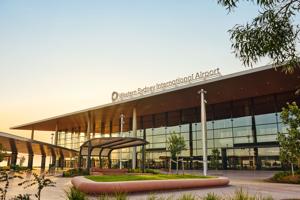
Major civil and terminal construction on Western Sydney International (Nancy-Bird Walton) Airport has reached completion seven months ahead of its baseline delivery schedule, project partners announced via reporting carried by the Prince William Times.
The multi-billion-dollar project marks Australia's first major greenfield international airport developed in more than five decades. Global engineering, procurement, and construction manager Bechtel led the terminal and airside integration program, coordinating with the Australian government and Western Sydney Airport corporation to deliver critical runway surfaces, apron zones, advanced baggage handling systems, and the central passenger terminal structure ahead of anticipated commissioning dates.
The development site covers roughly 4,400 acres in Badgerys Creek, approximately 27 miles west of Sydney’s central business district. The project scope required extensive earthworks, shifting more than 26 million cubic meters of earth to level undulating terrain before vertical construction began. The newly completed facilities feature a single 3.7-kilometer (2.3-mile) CAT III-B capable runway designed to handle wide-body commercial airliners, alongside an initial terminal capacity structured to accommodate up to 10 million passengers annually.
According to project documentation, the accelerated timeline stemmed from integrated project delivery models that consolidated procurement packages, parallel-tracked electrical and mechanical installations, and implemented digital modeling throughout structural erection. The facility now moves into an intensive testing, commissioning, and operational readiness trial phase ahead of scheduled commercial flight operations in 2026.
Executive Note — EGS Analysis: The Executive Takeaway
Large-scale infrastructure delivery projects face immense vulnerability during the transitional window between construction completion and operational commissioning. Delivering seven months ahead of schedule provides project managers an invaluable asset: expanded operational runway. When physical handoffs occur under compressed timelines, baseline site security, access governance, and perimeter management frequently experience friction as trade subcontractors demobilize while operational staff arrive.
Maintaining rigorous operational continuity during this interregnum requires treating physical access and asset controls as integral components of delivery rather than late-stage additions. For infrastructure leaders, early physical completion permits systematic stress-testing of perimeter perimeters, automated credentialing, and emergency workflows long before public access begins. This systematic discipline serves as a textbook example of proactive risk mitigation, demonstrating that schedule acceleration—when executed with structured management—can actually reduce operational exposure rather than create gaps.
Educational Sidebar: Phaged Commissioning and Critical Infrastructure Protection
The handover of complex facilities—from aviation hubs to regional distribution corridors—requires a structured transition framework known as operational readiness and airport transition (ORAT) or phased operational commissioning. Effective critical infrastructure protection during this phase hinges on three distinct pillars:
-
Subcontractor Demobilization and Credential Revocation: As construction teams complete closeout punch lists, access privileges must contract in real time. Physical master keys, temporary digital badges, and remote gate credentials represent significant residual liabilities if uninventoried during turnover.
-
Zonal Access Partitioning: Greenfield facilities must transition from open construction perimeters to strictly compartmentalized security zones. High-value areas, including baggage handling networks, primary electrical substations, airside corridors, and network server rooms, require isolated electronic access control and automated audit logging weeks before the full facility goes live.
-
Joint Scenario Testing: Before commercial opening, facilities require multi-agency simulation exercises. Integrating physical site operations, emergency services, municipal transport coordinators, and private facility operations validates communication redundancies and perimeter access protocols under real-world conditions.
EGS Security Solutions publishes a complimentary threat & vulnerability assessment framework for facility directors and asset managers in the DMV. Facility leadership can review the framework here: https://egssecuritysolutions.com/locations/manassas