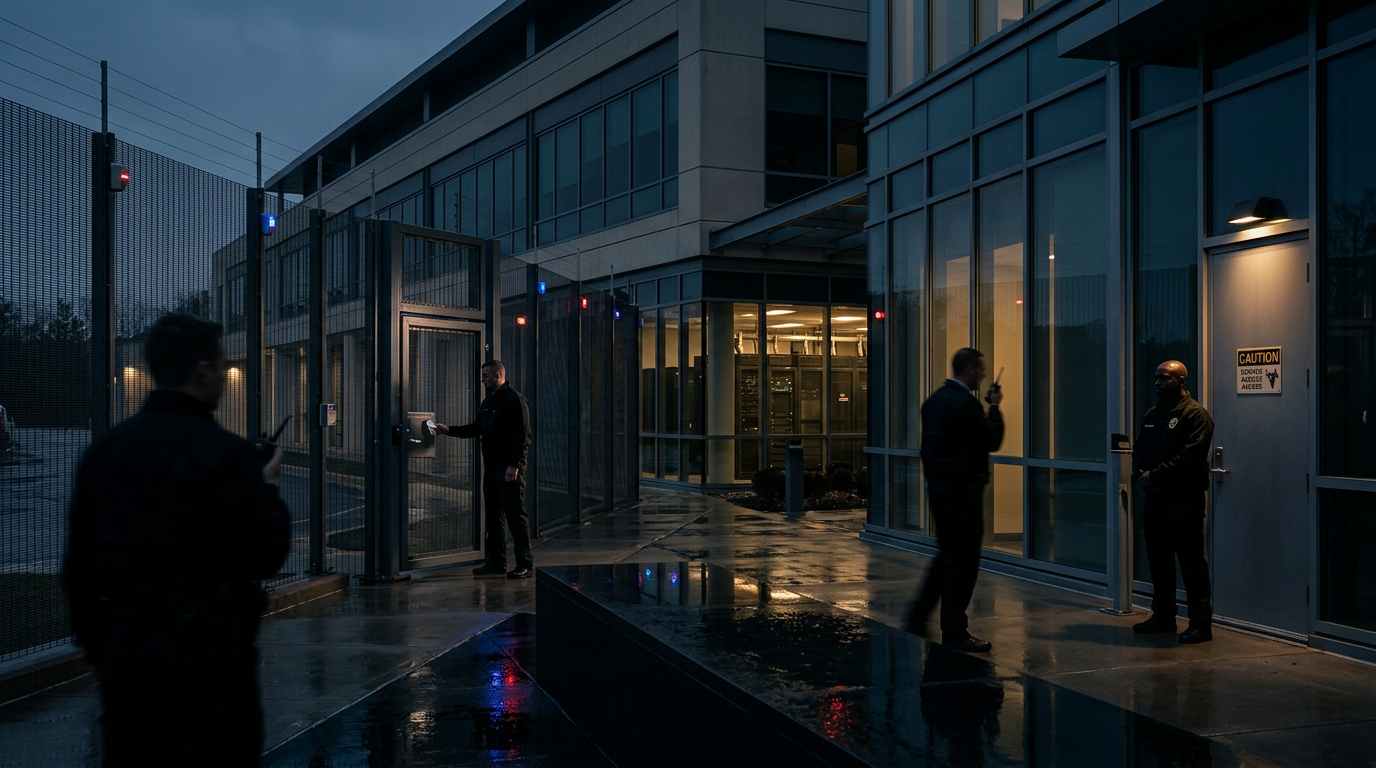
For facility directors and corporate asset managers across Prince William County, designing a physical protection plan often focuses on the perimeter: fences, gates, and locked doors. While critical, this represents only one half of a comprehensive security doctrine. A truly resilient strategy incorporates two distinct but complementary concepts: Denial of Access and Denial of Service.
Understanding this distinction allows decision-makers to move beyond a simple “keep them out” mindset and build a layered, in-depth defense that improves safety and preserves operational continuity.
The First Layer: Denial of Access
Denial of Access is the most familiar concept in physical security. It comprises all measures designed to prevent an unauthorized individual from gaining initial entry to a property, building, or restricted area. It is the outer shell of your protective posture.
Examples of Denial of Access measures include:
- Perimeter fencing and gate control
- Bollards and other anti-vehicle barriers
- Electronic access control systems (keycards, fobs, biometrics)
- Professionally staffed reception desks and gatehouses
- Window and door hardening
- Alarm systems that trigger on unauthorized entry
This layer’s primary function is to deter opportunistic threats and delay determined adversaries. By forcing an actor to expend time and effort to breach the perimeter, a robust access denial plan creates a critical window for detection and response. However, a prudent risk manager must assume that a sufficiently motivated actor may eventually defeat this layer.
The Second Layer: Denial of Service
Denial of Service is a more advanced strategic concept that assumes a breach has already occurred. Its goal is not to stop the entry, but to prevent the adversary from successfully carrying out their objective once inside the facility. It is about disrupting their plan, frustrating their movement, and containing the incident.
This is achieved by manipulating the internal environment and having response protocols in place. Examples of Denial of Service measures include:
- Compartmentalization: Using further access-controlled doors internally to create secure zones, preventing an intruder from roaming freely.
- Architectural Design: Designing hallways with bends to remove long lines of sight, or placing critical assets in areas that are difficult to access quickly.
- Safe Rooms: Designated, hardened shelter-in-place locations for employees.
- Internal Lockdown Protocols: Procedures that can be triggered by a duress alarm to secure internal areas, essentially creating new barriers on the fly.
- Trained Response: The presence of on-site protective service professionals trained to actively intercept, contain, and de-escalate an internal threat, rather than merely document it.
In a Manassas data center, Denial of Access is the biometric scanner at the main entrance. Denial of Service is the mantrap vestibule that follows, and the individually locked server cages that prevent an intruder who reaches the data hall from accessing specific assets.
For a corporate headquarters, Denial of Access is the lobby reception team. Denial of Service is the ability to lock down all elevators and stairwells from a central command point while directing staff to shelter in their compartmentalized office suites.
By integrating both principles, an organization creates a defense-in-depth. The outer layer delays the threat, and the inner layers disrupt and contain it, buying invaluable time and dramatically increasing the likelihood of a positive outcome.
Executive Note — EGS Analysis Adopting both Denial of Access and Denial of Service principles is the mark of a mature security posture. Focusing solely on the perimeter creates a brittle defense that fails completely upon a single breach. A holistic strategy that considers how the interior can frustrate hostile action not only enhances safety but also meaningfully reduces an organization's overall liability footprint through superior tactical architecture.
Educational Sidebar: Applying the Access/Service Framework
Use this brief checklist to evaluate how your facility's plan incorporates both strategic layers. Ask your physical security partner to walk through your site with these questions in mind.
- DETERRENCE (Access): What visible measures do we have (lighting, clear signage, professional presence) that would discourage a potential adversary from even making an attempt?
- DELAY (Access): If an unauthorized entry is attempted, how many distinct, time-consuming barriers must be defeated? (e.g., fence, locked door, internal checkpoint). What is the cumulative time to breach them?
- DISRUPTION (Service): Once an actor is inside, what prevents them from moving freely to their target? Can we lock down zones? Are there response protocols beyond calling law enforcement? Are there trained personnel on-site to actively contain the threat?
- DOCUMENTATION (Supporting): Is the entire potential path of an adversary, from the curb to the core asset, covered by auditable systems like cameras and access logs that will provide evidentiary value?
EGS Security Solutions publishes a complimentary threat & vulnerability assessment framework for facility directors in the DMV. Request it here: https://egssecuritysolutions.com/locations/manassas