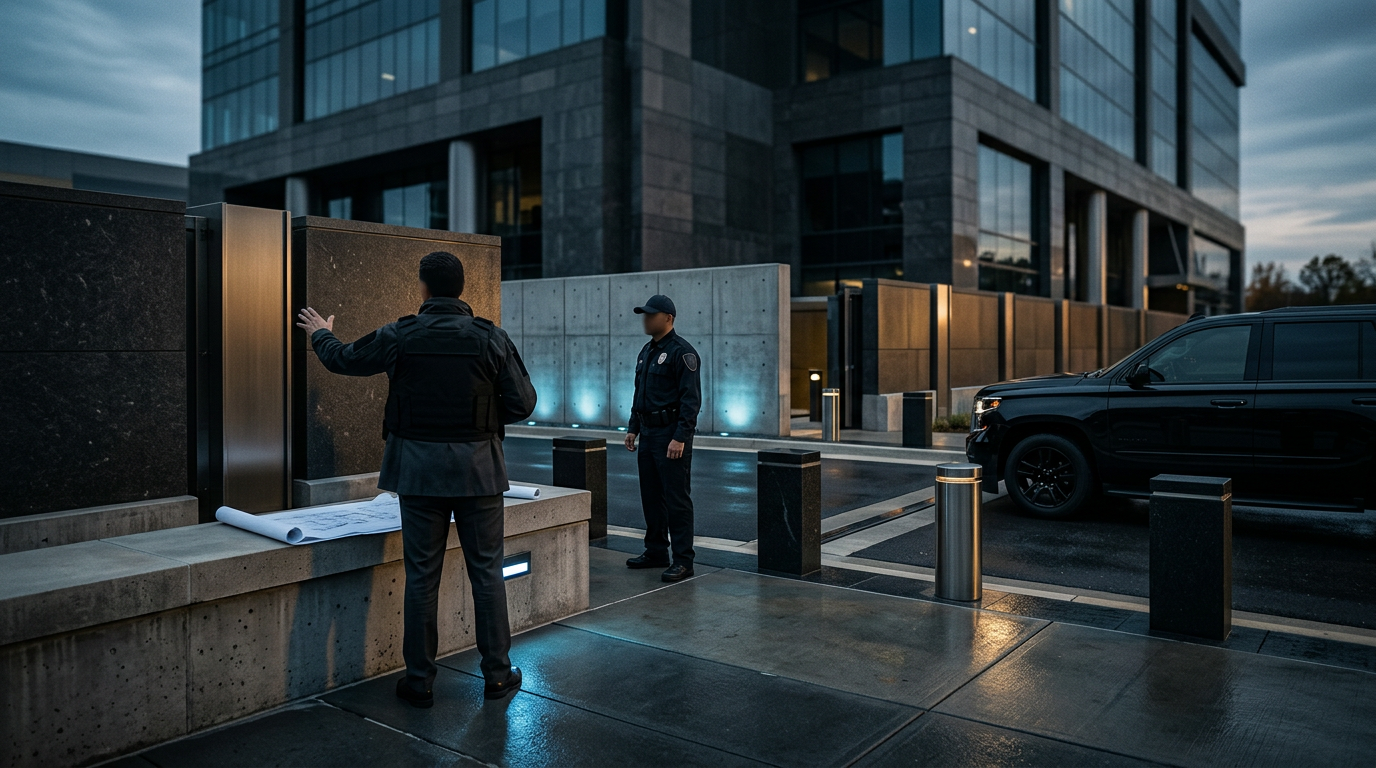
Hostile Vehicle Mitigation, or HVM, is a critical discipline within physical security that focuses on preventing unauthorized or malicious vehicles from accessing a site or causing harm. While often associated with high-profile government buildings or public squares, its principles are increasingly relevant for commercial properties, mixed-use developments, and community associations throughout Prince William County. The goal of HVM is not merely to block vehicles, but to do so strategically, creating standoff distances that protect people and structures from both deliberate attacks and accidental vehicle incursions.
An effective HVM strategy is a form of tactical engineering, deeply integrated into the site’s overall design and operational plan. It goes far beyond simply placing concrete barriers at a perimeter.
Passive vs. Active Mitigation Measures
HVM solutions are broadly categorized as either passive or active. Passive measures are static and fixed in place, forming a constant layer of protection. These are the most common solutions for commercial properties due to their lower maintenance and operational costs. Examples include:
- Bollards: These are robust vertical posts, engineered and installed to withstand significant vehicle impact. They can be aesthetically matched to a property's design and are often the most straightforward HVM solution.
- Reinforced Planters and Street Furniture: Heavy, specially constructed planters, benches, and even waste receptacles can serve a dual purpose. They enhance the public space while providing a formidable barrier to vehicles. This approach is ideal for creating a welcoming yet secure pedestrian area.
- Landscape and Architectural Features: Low retaining walls, berms, and strategically placed water features or sculptures can also be designed to stop a moving vehicle while blending seamlessly into the environment.
Active measures are moveable and designed to manage access for authorized vehicles. These are typically found at secure entry points and require a human operator or an automated system. They include retractable bollards, rising wedge barriers, and heavy-duty crash gates. While less common for general commercial use, they are essential for facilities with secure parking garages or sensitive loading docks.
The Importance of Engineering and Placement
The effectiveness of any HVM device is entirely dependent on its engineering and installation. A bollard that can theoretically stop a 7.5-ton truck at 50 mph is useless if it is installed in a shallow, weak foundation. Professional standards, such as those from the American Society for Testing and Materials (ASTM), provide crash ratings that define a barrier’s stopping power. When considering HVM, it's crucial to ensure the chosen product's rating is appropriate for the site's specific threat profile—considering likely vehicle sizes, approach speeds, and angles.
Equally important is the strategic placement of these barriers. A proper assessment analyzes vehicle dynamics and natural approach paths to a facility. The objective is to disrupt these paths far from pedestrian-heavy areas like building entrances, outdoor dining patios, and walkways. Simply lining a curb with bollards may not be sufficient if a vehicle can gain speed and strike at an angle between them.
For facility directors and HOA boards, the implementation of HVM is a tangible demonstration of a commitment to duty of care. It is a specialized field where design, engineering, and security operations converge to protect assets and, most importantly, people.
Executive Note — EGS Analysis Integrating HVM into site planning is a foundational element of modern tactical architecture. Its implementation is not an expense but an investment in proactive risk mitigation that hardens structural assets and protects human life. A well-designed HVM plan demonstrably shrinks a property's overall liability footprint by addressing a significant and foreseeable risk vector.
Educational Sidebar: HVM Initial Self-Assessment Checklist
Facility managers can use this checklist to perform a preliminary review of a property's vulnerability to vehicle incursions. This is not a substitute for a professional assessment but can help identify obvious areas of concern.
-
Identify Pedestrian Congregation Points: Where do staff, clients, or residents gather near vehicle traffic? Main entrances, outdoor seating, and shuttle bus stops are key areas.
-
Analyze Vehicle Approach Paths: Stand at your main entrance. What are the longest, straightest lines of approach a vehicle could take from the street or parking lot? Are they obstructed?
-
Evaluate Existing Barriers: Are your only barriers standard curbs or decorative landscaping? These offer minimal resistance to a deliberate or out-of-control vehicle.
-
Review Access Control Points: How are delivery zones, loading docks, and parking garages secured? Is access appropriately limited to authorized vehicles?
-
Consider Aesthetics and Environment: Do your security measures feel imposing? Can protection be better integrated into the landscape with multi-purpose elements like reinforced planters or benches?
EGS Security Solutions publishes a complimentary threat & vulnerability assessment framework for facility directors in the DMV. Request it here: https://egssecuritysolutions.com/locations/manassas.